 BookCloud
Why BookCloud exists
When children grow up across languages, their books should too.
Families raising a child across languages know the gap: the books you grew up with often don't exist in the language your child is growing up in, and no library near you can stock every language your family speaks.
BookCloud is our attempt at closing that gap: a free, ad-free reader of openly-licensed and public-domain stories that can be read, and read aloud, in each of your family's languages. It began with our own family, and it's growing one language and one book at a time.
Who's building this
Two parents, building for our own family first.
BookCloud is built by a husband-and-wife team raising a child across three languages. We wanted a library like this for our own child, so we built it. We're extending it slowly, with the parents and collaborators who tell us they wanted the same thing.
What we believe
A few convictions you can see in the product.
-
A child's reading time isn't for sale. No ads, no third-party trackers, no broker selling your child's attention to anyone.
-
Reading is reading. There are no points, streaks or scoreboards in BookCloud.
-
Built to be put down. Stories can pull your child back. We won't: no streaks, no "your character missed you," nothing that starts the next book for them. The app should be easy to leave.
-
We add to reading, we don't replace it. Every book opens ready to read together. BookCloud is for the stories your shelf doesn't have; paper books still come first.
-
We level books, not children. A reading level describes the book, and it's there for you. We never test your child, never rank them, and will never tell you they're "behind." Listening counts as reading.
-
Made for every kind of reader. Large, hyperlegible type and gentle motion come as standard for every child, because roughly one in ten is dyslexic.
-
Multiple languages aren't a niche. They're the reason BookCloud exists.
Where the stories come from
Our library belongs to the commons.
The stories on BookCloud aren't ours. They come from the public domain, where copyright has lapsed, and from non-profit publishers who share their work openly under licences like Creative Commons BY 4.0. Some of the public-domain tales we bring back as freshly illustrated picture books, retold for young readers.
A particular debt is owed to StoryWeaver, a non-profit children's publisher from Pratham Books whose openly licensed catalogue in hundreds of languages is part of what makes BookCloud possible. Every author, illustrator and translator is credited inside the book, alongside the upstream source, so you can follow a story back to the people who made it.
We chose open stories because a multilingual library only works if its stories are free to move: translated, narrated and shared across languages without permission letters. If you're a native speaker who could help review translations, or a parent willing to test stories with your family and tell us what works, we'd like to hear from you.
How the editions get made
Drafted with AI, reviewed by people, credited inside the book.
Some books are openly-licensed stories already shared in many languages. Others are public-domain tales we adapt into picture-book form and illustrate afresh. Doing that across many languages used to be the work of years, so we use AI to help draft the adaptation, the pictures, the translation and the narration.
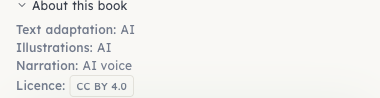
We review every edition before it reaches a child, and each book credits what a person made and what was AI-assisted, so you always know. Where a heritage language has almost no children's books at all, an AI voice is the difference between a story your child can hear in your language and no story at all. If something feels off in a story your child is reading, tell us.
Stage
On the App Store now, growing slowly.
BookCloud is free and on the App Store now, with the Android app on its way. The library grows language by language, and we'd rather get this right than get this big.
If what you've read here matches what you want for your family, write to us — to help review a translation if you're a native speaker, or just to tell us what's missing.